Alongside these opportunities, challenges such as data protection, privacy, and interoperability difficulties arise. The success of this transition requires coordinated legal and technical frameworks, open API standards, and responsible data governance. By reviewing international experiences, analyzing the underlying technology stack (Tech Stack), and examining regulatory requirements, this article assesses Iran’s current state—considering its domestic capacities and constraints—and proposes a phased roadmap for a secure and globally aligned advancement toward Open Finance.
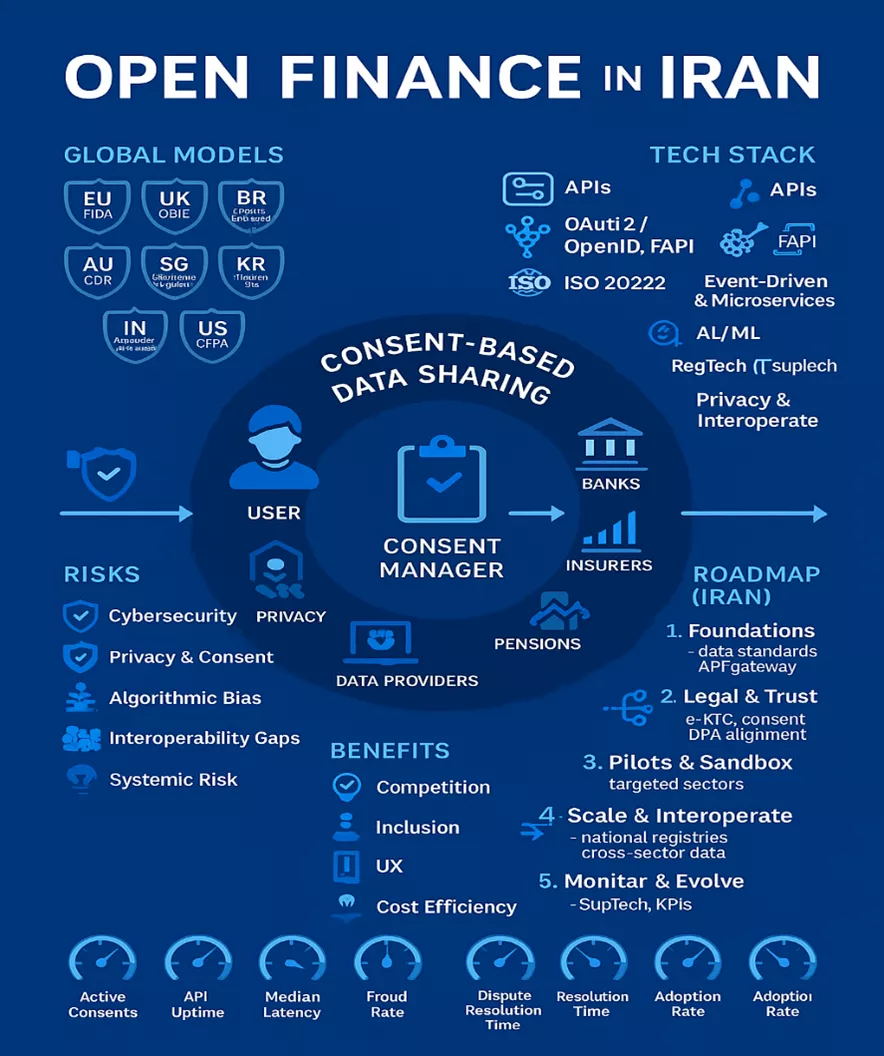
The article positions “Open Finance” as the evolutionary stage beyond open banking—expanding the scope of shareable data from payment accounts to domains such as lending, savings, investment, insurance, and retirement. Grounded in informed customer consent, this model enables secure data sharing. From a policy perspective, the experiences of leading jurisdictions are reviewed: the European Union with its FiDA framework and unified FDSS standard; the UK with the mandatory OBIE model; Australia with its cross-sectoral Consumer Data Right (CDR); Brazil with its phased standardization approach integrated with Pix; Singapore with APIX and SGFinDex; South Korea with MyData 2.0; India with its Account Aggregator model; and the U.S. with CFPB regulations aimed at moving beyond screen scraping. This review underscores the importance of agile regulation and common technical standards.
Technically, APIs are identified as the backbone of real-time, secure data exchange, offering clear advantages over screen scraping in terms of security and accountability. Standardization efforts such as FDX, ISO 20022, and FAPI are prerequisites for scalability. Moreover, microservices architecture, event-driven APIs, and emerging technologies act as enablers for enhanced user experience and operational efficiency. Corresponding risks—including cybersecurity threats, algorithmic bias, interoperability gaps, and infrastructural shortcomings—demand a robust data governance approach and continuous risk monitoring.
Regarding Iran, despite widespread adoption of digital payments (including the digital rial initiative), services remain largely confined to payments, KYC, and credit scoring, revealing a significant gap from true Open Finance. Existing frameworks—such as the National Data Management Law—create barriers to bank-fintech collaboration and consent-based data sharing. However, Iran’s identity and credit infrastructure (e.g., SAMAT and credit assessment systems) offer solid foundations for future enablement. The proposed conceptual model centers on the customer and dynamic consent, advocating for open API standards, bank-fintech collaboration, and smart supervision (RegTech/SupTech). Implemented through a phased roadmap—including infrastructure strengthening, legal reforms, data-sharing mechanisms, targeted regulatory sandboxes, and financial literacy initiatives—it paves a safe and locally adapted path toward Open Finance.